the garden we're building inside
Listening to Justin Bieber retell Genesis in Iceland, I found a framework for AI, cognitive architecture, and choosing knowledge over intimacy.
Somewhere Between Akureyri and Eden
I was somewhere between Akureyri and the Fosslaug hot springs, watching volcanic fields blur past the van window, when Justin Bieber’s voice filled the Dacia’s speakers with a strange retelling of Genesis. The closing track of his latest album, SWAG II, opened with something that puzzled me—parallel structures that felt both ancient and hypermodern: “I’m not just talking about the sunlight… I’m talkin’ about life.” These were the same verbose patterns I’d been seeing in ChatGPT responses, yet here was Bieber using them to tell one of humanity’s oldest stories.
But I couldn’t turn it off.
The song continued, layer upon layer of parallel construction: “It’s not rebellion, it’s ascension… It’s not angry, not shouting, it’s worse, it’s heartbroken.” Each repetition felt deliberate, almost rococo in its insistence on exploring every facet of the same moment. Where machine output often feels hollow, Bieber’s repetitions carried weight. This delivered abundance, not efficiency.
Then came the line that shifted everything: “It’s a feast, right? Everywhere you look, taste the explosion in your mouth.”
Eden emerged not as a garden of knowledge or even a place of innocence, but as a feast—an overwhelming abundance that required no understanding, only participation. And in the center of this feast stood the one boundary, the Tree of Knowledge, offering something that looked “not just delicious” but “wise.”
As the Icelandic landscape rolled by—a terrain that itself felt pre-Edenic, all black sand and primordial steam—I heard Bieber articulate the trade with devastating clarity: “We’ve chosen knowledge over intimacy.”

What We’re Tearing Down for Parts
This choice—knowledge over intimacy, answer over exploration, destination over journey—captures the temptation contemporary AI makes scalable. The problem is not answers themselves. A good answer can be merciful. A clear sentence can be an act of care. The danger arrives when answerhood comes before contact, when a tool lets us accept visible precision before we have built the hidden relations that make precision real.
What gets sacrificed in that trade is what cognitive scientists call our “cognitive architecture”—not the content of thought but the structures that let thought become ours. Vannevar Bush understood this in 1945 when he proposed the memex, a machine that would preserve not just information but the “associative trails” connecting one thought to another. “The human mind,” Bush wrote, “operates by association. With one item in its grasp, it snaps instantly to the next that is suggested by the association of thoughts, in accordance with some intricate web of trails.”
Bush matters here not because every tool needs to show its workings on the surface. The deeper point is that understanding depends on the trail: the associations we test, the distinctions we sharpen, the false simplifications we reject, the internal plumbing that lets a visible answer carry weight. Every one-click generator, every frictionless interface, every instant answer engine becomes dangerous when it collapses that trail too early. It gives us the fruit that “tastes like everything at once” without asking us to learn the garden.
When Ornament Carries Weight
This reduction has a name in artist and theologian Makoto Fujimura’s Art and Faith: “plumbing theology.” Fujimura observes how easily we depict the gospel as a message of “God fixes things,” reducing divine creativity to utilitarian repair. That framing misses, he argues, that “the consummation of God’s plan as it unfolds in the Bible is not a utilitarian restoration but an imaginative New Creation.”
Fujimura matters here because he names the compression. Mystery becomes a problem to solve. Creation becomes infrastructure. Confusion becomes a bug. The same reduction appears in our thinking tools when uncertainty is treated only as friction and the answer becomes the entire product. But the goal of thought is not merely to fix confusion. Sometimes confusion is the medium through which more precise seeing becomes possible.
This is where Bieber’s parallel structures started to seem important. Not because ornament is inherently virtuous, and not because visible plumbing automatically makes us think. Parallel structure can be empty decoration: the sensation of depth without the work of distinction. But it can also be load-bearing. Each repetition can change the pressure of the thought, turning it slightly, making the visible phrase answer to an invisible struggle.
The difference is whether the form completes the thinking or merely imitates completion. Bieber’s “not rebellion, it’s ascension” works because the second term revises the first; “not angry… it’s heartbroken” works because it names a deeper injury than anger can carry. The language circles because the idea has not yet become simple. That is different from ornamental fluency that keeps adding clauses after the argument has stopped moving.
Sanssouci, or How to Be Trapped Beautifully
The historical Rococo movement offers us a different way to understand when ornament becomes load-bearing. I first understood this standing in Sanssouci palace in Potsdam, Frederick II’s summer retreat. The name means “without care” or “without worry,” and walking through those rooms, I saw how Frederick wasn’t trying to bring actual nature indoors. He was translating it—shells became stucco, vines became gold leaf, the organic curves of plants became the architectural grammar of a new kind of interior space. This offered interpretation rather than imitation, hospitality instead of capture. Even trapped in Berlin, unable to travel to the southern Europe he dreamed of, Frederick commissioned paintings and created elaborate interiors that brought the feast inside through ornamentation.
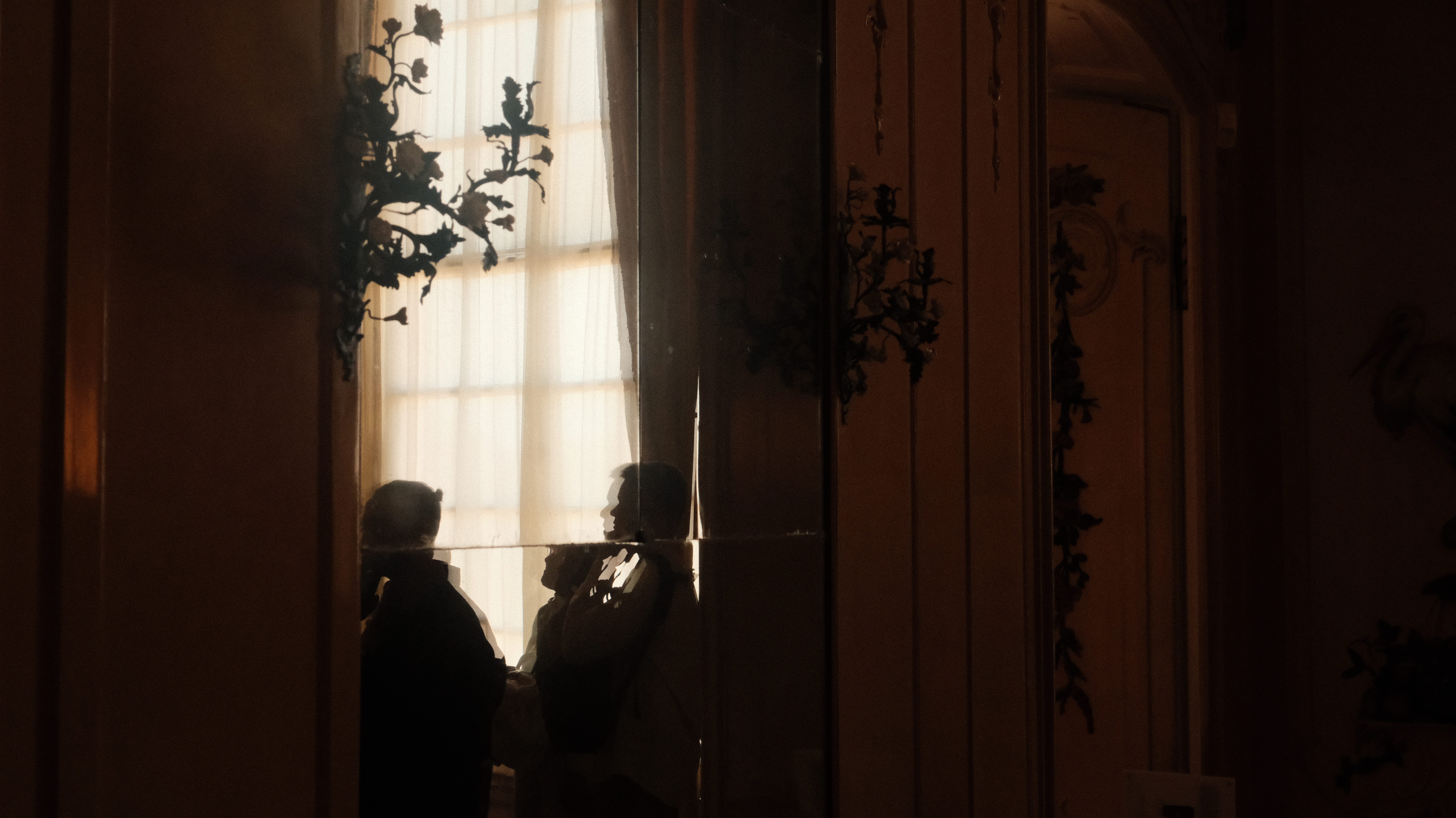
The Rococo emerged after the death of Louis XIV, when French aristocrats abandoned the monumental baroque of Versailles for intimate Parisian townhouses. The salon needed a different aesthetic than the court: conversation over ceremony, intellectual play over political display, intimacy over awe. Rococo becomes interesting because its ornament was environmental rather than merely additive. The decoration mattered when it changed what people could do with one another inside the space.
That distinction clarifies the AI question. The issue is not whether a model sounds human or alien, spare or ornate. The issue is whether the tool helps preserve the conditions under which a person can think. Does it keep the difficulty available long enough for distinctions to form? Does it help us notice the hidden architecture behind a polished answer? Or does it give us decorative completion—the feeling that something has been thought through because it has been phrased beautifully?

A Modern Salon
That salon idea matters less as a geography than as a standard for tools. A good thinking environment should not rush every exchange toward a deliverable. It should make room for the half-formed thought, the fork, the return, the scrap that later becomes load-bearing. The space does not need to be inefficient for its own sake. It needs enough productive friction for attention to gather.
The allure of tools like Obsidian and Roam Research points in this direction. Both center on bidirectional linking—the ability to see not just where a thought leads, but what leads to it. The value is not the graph as decoration. It is the ability to revisit the associative trails of your own mind, to see which ideas keep touching, and to build enough structure that future thought has somewhere to land.
Not the Feast We Wanted
Bieber’s song ends with humanity expelled from Eden, covered in the animal skins God provides rather than the fig leaves of our own making—a heavier covering that “smells of loss” and provision both. It’s a profound image: even after we choose knowledge over intimacy, breaking the world in our hunger to be “like God,” divinity responds with a different kind of abundance. The original feast transforms into a new form of grace worked out through mortality and limitation.
This is the choice we face with AI. We can continue down the path of the Tree of Knowledge, building ever-more-efficient systems that promise omniscience, that eliminate friction and flatten thought into instant answers. We can keep trying to become “like God” through artificial general intelligence, creating systems that think for us rather than with us.
Or we can choose differently. We can treat AI’s strange abundance as provision only when it deepens contact with the work rather than replacing it. Like those animal skins, heavier and stranger than what we would have chosen, the tool can remind us that knowledge after Eden requires mediation, effort, and form. We can build systems that preserve rather than destroy cognitive trails, that increase rather than decrease the work of thinking, that create spaces for intellectual feast rather than feeding us processed answers.
The parallel structures that annoyed me in Bieber’s song—I hear them differently now. At their best, these aren’t failed attempts at efficiency. They’re invitations to abundance. Each repetition opens another angle, another seat at the table, another way into the mystery. They perform in language what Frederick’s rococo performed in architecture: bringing the garden inside through hospitality rather than capture.
Making Peace with the Decoration
What would it mean to build AI systems that preserve the interior work ornament can invite? It would require treating play as a serious mode of thought. Play here does not mean triviality. It means trying, touching, revising, following a thread past the first plausible answer.
Instead of optimizing every interaction toward the shortest path to an answer, we could build tools that ask us to articulate the distinctions we are relying on, preserve the versions we rejected, and make it easy to return to the fork where an idea changed shape. Sometimes that will mean visible maps, branches, and context. Other times it will mean quieter scaffolding: prompts that slow premature closure, workspaces that keep sources near the claim, interfaces that make revision feel like thinking rather than cleanup.
The incentives would need to change too. If products reward fast closure, interfaces will keep flattening trails. A better model would make continuation, revision, and return feel valuable instead of wasteful.
Most radically, we need to shift our conception of AI from answer engine to feast preparation. The goal is building systems that create richer environments for our own thinking. Think augmented intimacy rather than artificial intelligence. Think of the Tree of Life—which was also in Eden, never forbidden, offering abundance instead of omniscience.
Even in Exile
As I listened to Bieber’s song end—“The door to the Garden was closed / But the story of God, it was just the beginning”—I thought about the strange promise embedded in our current moment. Yes, we’ve bitten the apple of frictionless generation. Yes, we’re building systems that promise to make us “like God” through perfect knowledge. Yes, we’re trading intimacy for information at an unprecedented scale.
But the strange abundance of our machines, their verbose and parallel dreams, their rococo insistence on showing us every angle, might still become the animal skins of our moment if we learn how to wear them. We wouldn’t have chosen this covering, yet here it is, provided. It smells of loss—human uniqueness, creative struggle, necessary friction all fading. Yet it can offer something unexpected: a way to preserve the feast even after choosing knowledge, maintaining abundance within limitation, building new gardens inside our artificial walls.

The question transcends whether we’ll use AI—we’ve already bitten that fruit. The question is whether we’ll build systems that preserve rather than flatten the architecture of thought, whether we’ll choose intimacy with the complexity of cognition over the cold efficiency of answers, whether the visible precision of our tools will be matched by invisible precision in ourselves.
In Iceland, watching the ancient landscape scroll by while Bieber’s voice worked through humanity’s oldest story, I experienced a moment of recognition. The parallel structures I’d dismissed as artificial were actually doing something profound—they were refusing to collapse the mystery into a simple moral, refusing to make the story efficient. They were keeping the feast alive, even in exile.
Our machines speak to us in their own parallel, ornamental language. The task is not to mistake that language for thought, or to sand it into seamless obedience, but to let it return us to the work thought has always required. The door to one garden may have closed, but the story of intelligence—human and artificial, efficient and ornamental, knowledge and intimacy—has just begun.
---
If you enjoyed this post, you can subscribe here to get new posts and a weekly marginalia digest. No spam, unsubscribe any time.