sacred saddlebags
Medieval portable altars traveled from Denmark to Constantinople. What do portable tools teach us about practice between institutions?
Danish merchants in the 11th century carried their churches in saddlebags. Not metaphorically—literally. Small oak boxes with gilded copper plates, collapsible frames that held consecrated relics. While Rome built St. Peter’s Basilica, while Paris erected Notre-Dame, the Danes developed something different: sacred spaces designed for movement.
I learned this in Copenhagen’s National Museum, weeks ago now, staring at these portable altars that once traveled from Denmark to Constantinople. The communities that used them were too small, too scattered, too nomadic for cathedrals. So they innovated. They made the sacred portable.
After leaving Spotify, I’ve been thinking about institutional belonging and the tools we use when we’re between cathedrals. My laptop holds years of reflections. My phone contains voice memos from Pyrenean hikes. Digital spaces where I’ve been building something, though I couldn’t name what. The portable altars helped me understand: maybe the wandering itself is the point. Maybe the tools we carry shape the thoughts we’re able to think.
The Weight of What We Carry
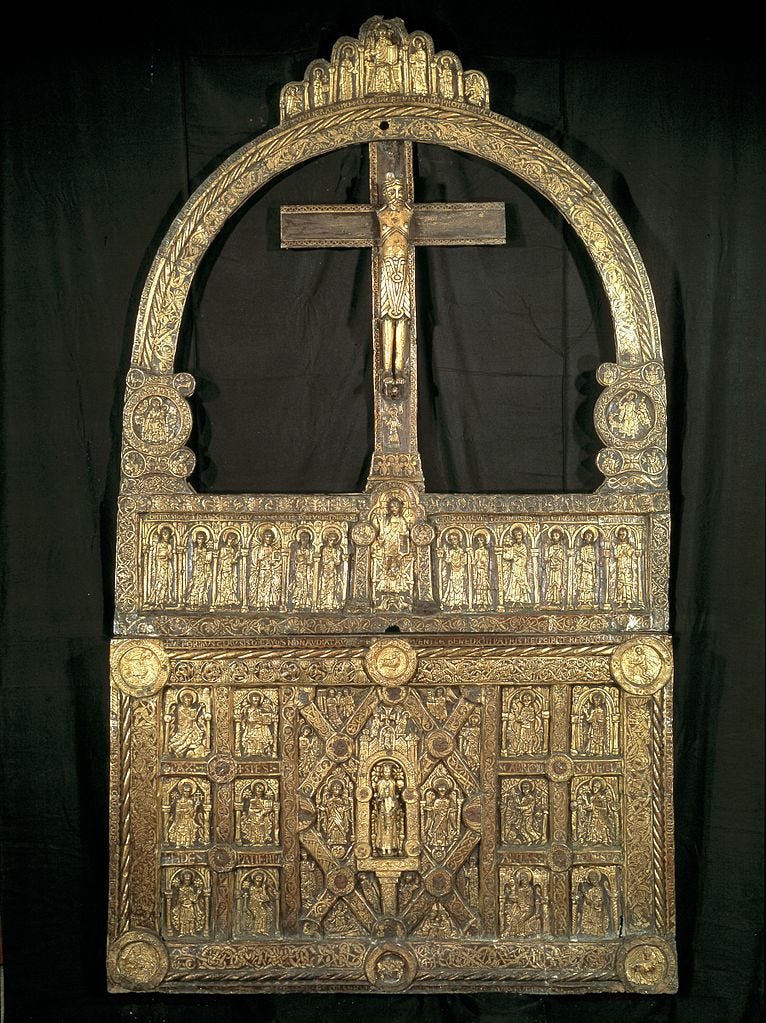
The Lisbjerg Altar, one of Denmark’s finest surviving examples, weighs just enough to be carried by one person. Oak core, gilded copper plates, dated to 1135 by the growth rings in its wood. It features the Virgin Mary surrounded by prophets, each figure hammered into the metal with tools we can only imagine. Some craftsman (we don’t know his name) spent months creating this elaborate framework that could collapse into a travel case. The altar contained relics of at least two saints, because that’s what made it legitimate. Without those fragments of bone or cloth, it was just decorated wood and metal.
I think about legitimacy often. In tech, we carry our credentials differently: GitHub repositories, LinkedIn profiles, the companies on our resumes that signal we’ve been consecrated by the right institutions. When I left Spotify, people kept asking what was next, as if the gap between cathedrals needed immediate explanation. But Archbishop Anders Sunesen spent the winter of 1206 in Riga with just his portable altar and his books, developing the Hexaemeron, a theological work that would reshape Northern European thought. He needed the winter. He needed the distance from Lund Cathedral. He needed tools that traveled.
The economics matter here. Roskilde Cathedral consumed three million bricks and a century of construction, requiring the patronage of kings and the labor of thousands. Building sacred space at that scale demands submission to institutional logic: bishops’ oversight, royal politics, the slow accumulation of capital and power. But a portable altar? The research tells us a commissioned one cost about what a skilled craftsman earned in two months. Achievable for an individual. Personal investment rather than institutional dependency.
Tools for the Wandering
Thai forest monks call it tudong: wandering practice. They carry iron bowls in cloth slings, umbrella tents that become meditation halls wherever they stop. The Vietnamese monk Thich Minh Tue caused controversy in 2024 by practicing this way, sleeping in cemeteries, walking barefoot across provinces. The state Buddhist organizations condemned him. His practice was irregular, unsupervised, outside the proper channels. But thousands followed his journey online, recognizing something authentic in his portable practice that the temples couldn’t provide.
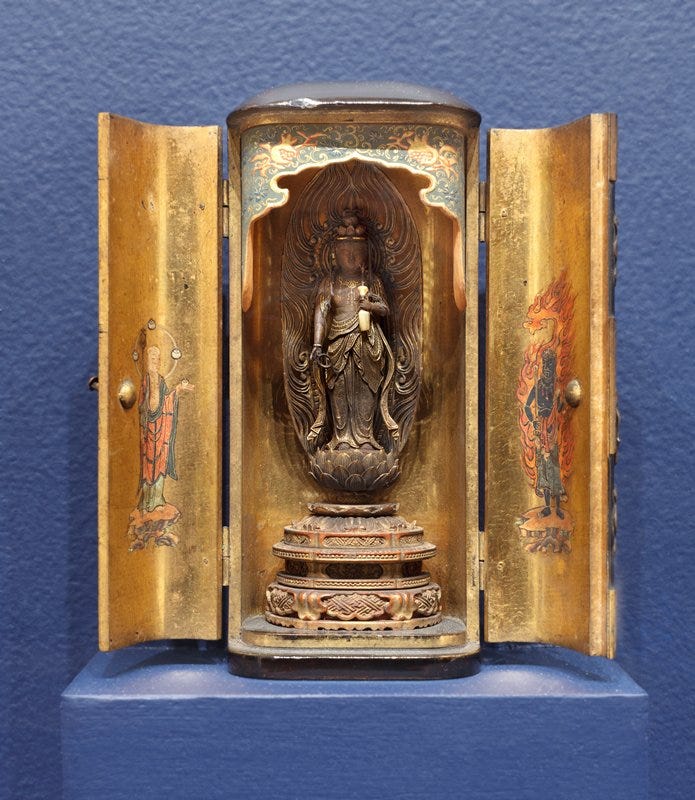
This pattern repeats across traditions. Japanese merchants carried zushi, shrine boxes with doors that closed for travel, opening to reveal Buddhist figures in miniature sacred spaces. Tibetan nomads wear gau, small metal cases containing prayers and relics, worn close to the body so the sacred literally moves with every step. Each culture solving the same problem: how do you maintain practice when the institution is distant, hostile, or simply irrelevant to your daily reality?
The anxiety these objects provoked in institutional authorities reveals their power. In 6th-century Gaul, bishops condemned priests for using portable altars to conduct services in private homes, especially because they were allowing women to participate as “conhospitae,” co-hosts of the sacred. The portable altar enabled practice outside cathedral walls. More importantly, it enabled different practice, experimental practice, the kind that challenges who gets to hold sacred authority.
Digital Pilgrims
We’re all carrying portable altars now, though we call them different names. Personal knowledge management systems. Second brains. Digital gardens. The tools proliferate (Obsidian, Notion, Roam) each promising to be the perfect container for thoughts that don’t fit in institutional frameworks. I watch friends build elaborate systems, investing the kind of attention medieval craftsmen gave to gilding copper plates. The same drive to create personal sacred space, to carry your practice with you.
But there’s something more happening. The medieval portable altar required relics to be legitimate, physical fragments that connected the user to larger sacred stories. Our digital tools hunger for different relics. We embed tweets, clip articles, save highlights from books we’ve read. We’re collecting fragments of thought that validate our individual practice, that prove we’re connected to conversations larger than ourselves even as we work alone.
When those Breton priests let women co-host the Eucharist using portable altars, they were demonstrating that portable tools enable fundamentally different approaches to the sacred. Similarly, when someone builds a personal AI assistant that helps them think, when they create a notes system that connects ideas in ways their company’s knowledge management never could, they’re exploring what becomes possible when the tools of thought become truly personal.
The Cathedral Optional
There’s a Portuguese phrase: “O caminho faz-se caminhando,” the path makes itself by walking. The pilgrims in the Pyrenees understood something about portable practice that I’m only beginning to grasp. They carried minimal supplies but elaborate inner worlds. What you carry makes the journey sacred.
The research on portable altars reveals a consistent pattern: breakthrough thinking happens because of institutional absence, not despite it. Anders Sunesen’s theological innovations during his winter in Riga. The Countess Gertrude commissioning her gem-encrusted altar that declared her own spiritual authority. The forest monks whose wandering practice revitalized Thai Buddhism. Each story suggests that portability creates conditions for discovery that institutions, by their very nature, cannot provide.
I’m writing this as a reflection, weeks after standing in that Copenhagen museum. The same tools I had in Berlin, in the Pyrenees, in the Black Diamond library. The tools travel. The practice continues. What I’m building (this collection of reflections, questions, connections) doesn’t need a cathedral to be legitimate. It needs only to be carried, to be used, to enable the kind of thinking that happens in motion.
What We’re Really Building
The economics of portable intent have shifted radically. A Claude subscription costs less than a coffee habit. A personal knowledge management system runs on any device. The tools that once required institutional backing (research assistants, libraries, publishing platforms) fit in our pockets. Yet we’re still thinking in cathedral terms, still seeking institutional validation for practices that have already escaped institutional control.
The Danish portable altars suggest another way. Their makers understood that sacred practice could be simultaneously personal and legitimate, mobile and meaningful, outside the cathedral yet still connected to larger traditions. They built tools for spiritual entrepreneurs, for those whose practice couldn’t wait for proper buildings or official permission.
We need new language for what we’re doing. “Content creation” frames our work as filling institutional containers. “Thought leadership” implies followers and hierarchy. Maybe something closer to what those medieval craftsmen understood: we’re making tools for portable practice, instruments for individual exploration that remain connected to communal knowledge without requiring institutional mediation.
The portable altar enabled medieval nobles to maintain spiritual practice during military campaigns, merchants to worship on trade routes, missionaries to carry the sacred into new territories. Our portable tools (these apps and systems and AI assistants) enable something similar. They let us maintain intellectual practice outside corporate frameworks, explore ideas on our own terms, carry our work across the gaps between institutions.
The Invitation
Countess Gertrude’s portable altar from 1045 bears an inscription: “Gertrude offers to Christ, to live joyfully in him, this stone that glistens with gems and gold.” She wasn’t asking permission. She was declaring her own covenant, establishing personal religious authority through an object she could carry.
We’re in a similar moment now. The infrastructure of thought—AI assistants, PKM systems, digital tools—has become radically portable and personally accessible. We can build our own instruments for intellectual and spiritual practice. We can carry them anywhere. We can use them to think in ways that institutions haven’t imagined yet.
The medieval portable altar makers understood that innovation happens at the edges, in the spaces between cathedrals, carried by individuals who can’t wait for institutional permission to explore what matters to them. Their altars weren’t compromises or substitutes. They were different instruments entirely, designed for a different kind of practice.
I keep returning to that Copenhagen museum, to those small weathered objects that crossed continents in saddlebags. They remind me that the most transformative tools are often the most personal ones, the ones we carry close, the ones that travel with our questions rather than delivering us to predetermined answers.
The path makes itself by walking. The tools we carry become the thoughts we think. And sometimes, the most sacred practice happens not in the cathedral but in the wandering itself, in the space between institutions where new forms of meaning can emerge.
---
If you enjoyed this post, you can subscribe here to get new posts and a weekly marginalia digest. No spam, unsubscribe any time.